
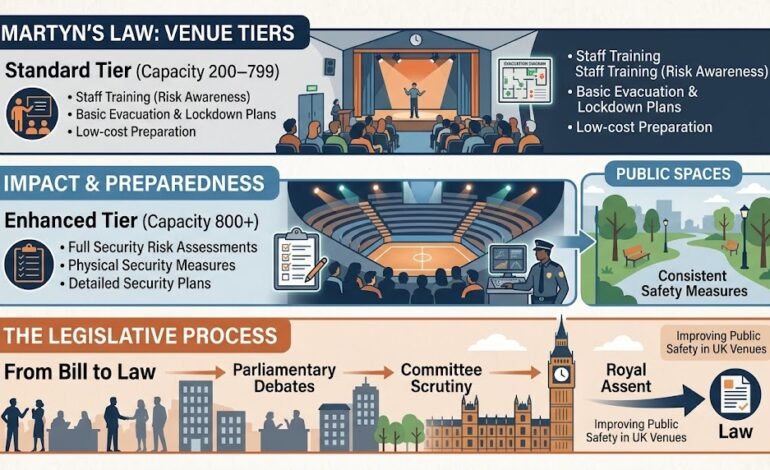
What is Martyn’s Law?

In simple terms, it is a UK safety rule. It makes public places safer from bad people who want to hurt others. When many people gather in one spot, safety is important. Places like shops, arenas, and schools must have plans for emergencies.
If something dangerous happens, workers must know how to help. This rule helps save lives. It makes sure venue owners think about safety every day. People should feel happy and safe when they go out to play or shop. Big sports matches like a game between the isecurity solutions need good security plans too.
Everyone needs to work together to keep public spaces safe. The new rule gives venue leaders clear steps to follow. It is all about stopping bad actions before they happen and keeping families secure.
| Key Feature | Quick Details |
| Official Name | Terrorism (Protection of Premises) Act |
| Main Goal | Keep public venues safe from attacks |
| Standard Tier | Places for 200 to 799 people |
| Enhanced Tier | Places for 800 or more people |
| Main Regulator | Security Industry Authority (SIA) |
Introduction about Martyn’s Law?
Understanding What is Martyn’s Law helps us see why safety laws matter. Officially known as the Terrorism (Protection of Premises) Act, it was passed by the government to protect people in busy places.
In the past, many public spaces did not have clear plans for terror events. This law changes that completely. Now, venue managers must think about threats and prepare simple safety actions.
People often ask what is martin’s law when they hear about new security measures at concerts or sports games. It is a system that asks venues to train their teams and lock doors fast if danger comes near.
By making these actions mandatory, public spots become much safer for children, parents, and workers. It turns helper ideas into clear rules for everyone to follow.
The 2017 Manchester Arena Attack
This safety rule exists because of a very sad event. In May 2017, a dangerous attack happened at the Manchester Arena in England. Many young people were attending a music concert. Suddenly, a bomb went off, killing 22 innocent people and hurting many more.
One of the people who died was named Martyn Hett. He was a young man full of life and joy. After the tragedy, safety experts looked closely at what happened. They saw that venues needed better ways to protect visitors and act fast in crises.
The attack showed that big crowds need strong safety plans. Everyone realized that public spaces must be better prepared for sudden danger.
Figen Murray’s Campaign
After Martyn Hett died, his brave mother, Figen Murray, wanted to make a change. She did not want other families to feel such deep pain. She started a big movement called martyn’s law to ask the government for safer public places.
Figen talked to leaders, walked hundreds of miles, and spoke to news channels. She asked for a law that forces venues to train staff for emergency situations. Her hard work inspired thousands of people to support her cause.
Because of her love and effort, lawmakers listened. Her campaign proved that one person can make the world much safer for everyone. Today, her work protects millions of people going out to enjoy life.
Alignment with the UK CONTEST Strategy
The UK government has a big master plan to fight terrorism called the CONTEST strategy. This strategy has four main parts: Prevent, Pursue, Protect, and Prepare. The new legislation fits right into the Protect and Prepare parts.
It helps lower the risk of harm in spaces where people gather. Some people confuse this with military rules and ask what is martial law law or what is martial law class in school, but those are completely different concepts about army control.
This safety law focuses on civilian venue preparedness. It aligns perfectly with national safety goals by making sure everyday places like shops, halls, and stadiums are ready to act if danger appears.
Qualifying Premises & Capacity Thresholds
Not every small shop has to follow the exact same rules. The law sets simple rules based on how many people can enter a building at the same time. This is called the capacity threshold.
To qualify, a place must be a permanent building or event ground open to the public. Smaller spots with under 200 people do not fall under the main duties. However, venues that hold 200 people or more must comply.
People learning legal history sometimes ask what is the martin act, which is an old financial rule in New York, or martin’s rule, but in UK safety, capacity numbers decide everything. Knowing your venue size helps you pick the right plan.
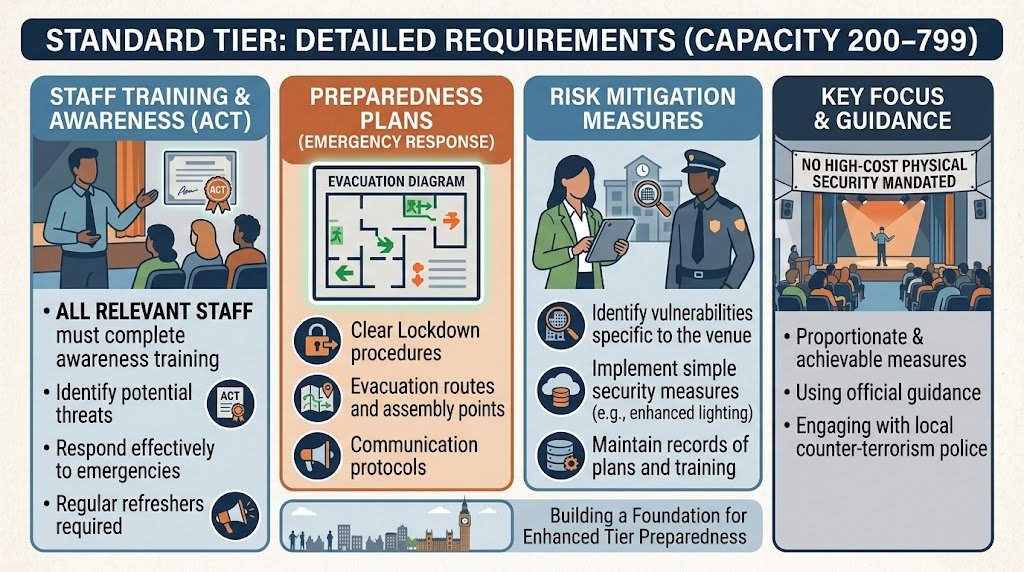
Standard Tier Requirements (200–799 Capacity)
Venues that hold between 200 and 799 people are in the Standard Tier. These are medium-sized places like local theaters, restaurants, small concert halls, and large churches.
The rules for this group are kept low-cost and simple so businesses can follow them easily. Venue owners do not need to buy expensive equipment. Instead, they must create clear response procedures.
They must notify official regulators about their venue and train their workers. Staff must learn simple ways to guide people to safety, lock doors, and call emergency services fast. These basic actions help protect visitors without putting hard financial burdens on small business owners.
Enhanced Tier Requirements (800+ Capacity)
Large venues that host 800 or more people belong to the Enhanced Tier. This includes large football grounds, big arenas, and giant outdoor festival spaces. Because so many people gather here, the danger is higher if an attack happens.
These venues must take bigger steps. They must conduct detailed safety risk assessments and write down formal security plans. They must also appoint a senior leader to oversee safety measures.
Measures can include bag checks, metal detectors, CCTV security cameras, and trained security guards. These strong safeguards ensure big crowds stay safe while enjoying major public events.
Exemptions and Special Category Rules
Some places do not have to follow these specific venue laws. These are called exemptions. For instance, places that already have heavy state security, like military bases, are excluded.
Most primary and secondary schools are also given special rules so they do not face unnecessary red tape, though they still maintain standard school safety steps. Small stores with space for fewer than 200 people are exempt as well.
When people ask what is martial law in legal terms, they learn it means military rule over civilians, which is very different from these civil venue safety exemptions. These special rules make sure enforcement stays fair and focused on high-risk locations.
Role of the Regulator (SIA Supervision)
To make sure venues follow the rules, a trusted group acts as the watchdog. In the UK, this regulator is the Security Industry Authority, or SIA. The SIA checks that venues register their spaces correctly and complete required safety plans.
They offer helpful guidance and advice to business owners. However, if a venue ignores the law, the SIA has the power to inspect buildings and issue warnings.
Their main goal is not to punish people, but to help every venue build a strong safety plan. With SIA supervision, the public can trust that venues take safety seriously every single day.
Mandatory Staff Training & Security Awareness
Workers are the first line of help during an emergency. That is why staff training is a key requirement of the new law. Every employee needs to learn how to spot unusual actions and react fast.
Many use online learning tools like Action Counters Terrorism (ACT) awareness modules. Staff learn what is the scan acronym used for martyn’s law, which stands for See, Check, Notify. This simple tool teaches workers to See something unusual, Check if it is dangerous, and Notify security or police right away.
Simple awareness training helps workers stay calm and save lives when seconds count.
Emergency Response Protocols (Evacuation, Invacuation & Lockdown)
When trouble happens, venues must know instantly what to do. There are three main ways to protect people inside a building:
- Evacuation: Moving everyone quickly out of the building to a safe outdoor location.
- Invacuation: Bringing people from dangerous outside areas inside to a safe interior room.
- Lockdown: Locking all outer doors and windows to keep a bad person from getting inside.
Staff must practice these protocols so they can direct crowds smoothly. Clear loudspeakers and quick alarms help tell visitors where to go. Having these three options ready keeps everyone safe no matter where the threat is located.
Physical Security Measures & Risk Assessments
Physical checks help block bad things from entering a venue. Large venues must write a thorough risk assessment that looks at potential weak spots in their building.
They check entrances, back doors, and parking areas. Depending on the risk, venues may add physical security tools. These can include strong door locks, security fences, clear lighting, CCTV cameras, and vehicle barriers.
If someone asks what are martin’s safety requirements or what is martin’s law in the uk, it refers to these practical physical steps. Good physical security stops threats before they get close to crowd spaces.
Penalties and Enforcement Mechanisms
Laws only work well if people follow them. That is why the SIA has strict rules for venues that break the law. If a venue forgets to train staff or hides security risks, the regulator gives them time to fix the problem.
However, if a venue refuses to comply, they face severe penalties. The SIA can issue heavy financial fines to venue owners. For major violations at large venues, fines can reach millions of pounds.
In extreme cases, non-compliant venues can be closed down completely until they prove they are safe. These strong penalties ensure everyone takes public safety seriously.
Implementation Timeline & Transition Period
Changing rules across a whole country takes time. The Terrorism (Protection of Premises) Act received Royal Assent in April 2025. The government set a transition period of at least 24 months.
This gives businesses time to build safety plans without rushing. During this implementation window, official statutory guidance was published to explain exact requirements. Full enforcement begins after the transition period ends.
| Timeline Phase | What Happens |
| April 2025 | The Act becomes official law (Royal Assent). |
| 2025 – 2026 | Home Office and SIA publish official guidance. |
| 2025 – 2027 | 24-month transition period for venues to prepare. |
| 2027 Onward | Full SIA enforcement and compliance checks begin. |
This transition gives every venue time to train workers and secure their premises properly.
FAQS
What is Martyn’s Law?
Martyn’s Law is a United Kingdom safety law that helps protect people in public places. It requires venue owners to prepare simple safety plans for emergency events. These security steps help keep visitors safe from potential terrorist attacks.
Who is Martyn’s Law named after?
The law is named in honour of Martyn Hett. He tragically lost his life in the 2017 Manchester Arena attack. His mother campaigned bravely to create this new safety law.
When does Martyn’s Law come into force?
The law passed in Parliament on 3 April 2025. It is expected to come into full force in Spring 2027. This gives businesses two years to prepare their safety plans.
What venues are affected by Martyn’s Law?
The law affects many public venues like sports stadiums, concert halls, and shopping centers. It also includes restaurants, bars, museums, and large outdoor event spaces. Any venue host who welcomes big crowds must follow these rules.
Is Martyn’s Law now a legal requirement?
The Act is now an official law on the books. However, venues do not face strict legal enforcement quite yet. Full legal compliance will become mandatory starting in Spring 2027.
What are the two tiers in Martyn’s Law?
The rules are divided into a Standard Tier and an Enhanced Tier. Standard covers smaller venues with light safety rules. Enhanced covers very large venues with stricter safety measures.
What are the penalties for non-compliance with Martyn’s Law?
Venues that ignore the law will face heavy financial fines. Standard tier businesses can be fined up to ten thousand pounds. Enhanced tier venues can face massive fines up to eighteen million pounds.
Does Martyn’s Law apply to small businesses or community halls?
Most small businesses and small community halls are not affected. The law completely ignores small places that hold fewer than two hundred people. Small shops can operate normally without setting up special plans.
What is the capacity threshold for Martyn’s Law?
The standard tier starts at a minimum capacity of two hundred people. The enhanced tier applies to massive venues holding eight hundred people or more. Anything holding under two hundred people falls outside the law.
What do businesses need to do to prepare for Martyn’s Law?
Businesses should review official government safety guidance. They need to train their staff on emergency procedures. Venue managers must also register their property details with the regulator.